
Why We Should Stop Erecting Statues
Toppling, techno-fascism and the Third Republic

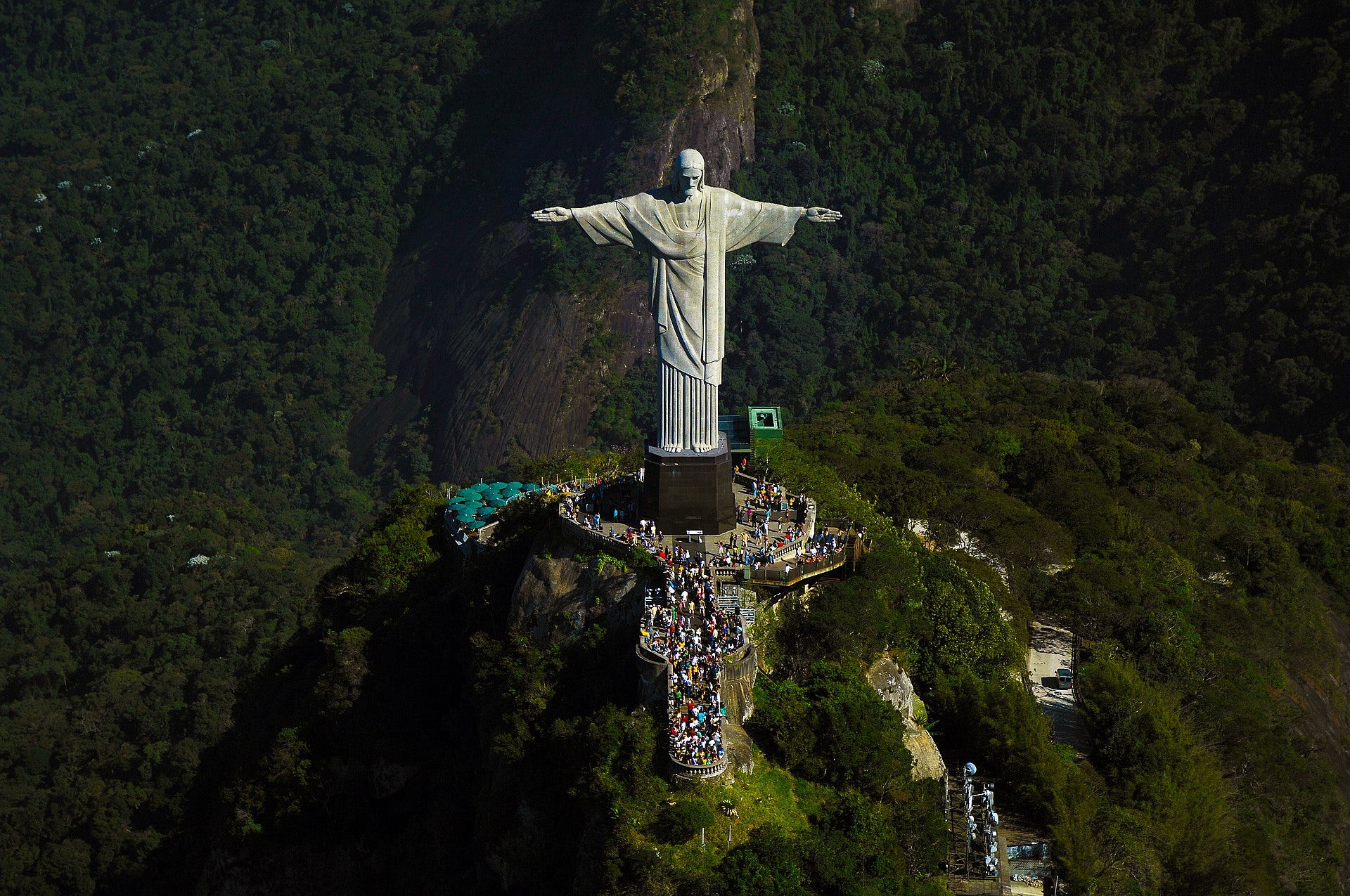
I started writing this before going to Rio De Janeiro and seeing Christ the Redeemer. Not up close, but from afar, atop the Corcovado mountain—the Art Deco statue partly obscured by clouds but still visible even to my weak eyesight. I hadn’t known much about the statue other than what it looked like; a 98-ft tall white Jesus with outstretched arms. I hadn’t realised how high up it was, how it overlooked the city in an all-seeing, all-knowing kind of way. For a moment, flying by in an Uber, bending my head out of the window, I had a brief moment of awe. If you happened to be on the verge of Christian conversion, and needed a sign— looking up at the concrete and soapstone statue from the ground, I can imagine the impulse to come forth, to repent and be saved.
It’s one thing to see Christ the Redeemer unintentionally for a few seconds from a car, tipsy from Cachaça and sleep deprivation, and another to hike 3 hours to see it up close. Two million people visit the statue annually, making it the most visited public statue in the world after the Statue of Liberty. What kind of experiences do people have up there? I check Trip Advisor. In the positive reviews, people discuss its excellent condition, how well maintained it is, the breathtaking view. I click on the one star reviews: “Arriving there, there was an immense queue, in the meantime it was getting dark. Eventually we left the queue and demanded our money back. There were still 3000 people on the mountain waiting in the dark.” Another one says: “the entry to the site is completely corrupt.” It seems like any transcendent experience the statue may elicit is ruined by overcrowding, bad organisation and possible violence. Dozens of tourists were held at gunpoint in a mass robbery as they hiked to see the statue in 2019.
I look up the 1 star reviews of the Statue of Liberty on Trip Advisor, to see if the same issues run true in New York. Reviews say that “overtourism has ruined the experience,” and talk of “corrupt and rude park staff”. This isn’t the crux of my argument—that we should stop erecting statues because of overtourism and crooks. I just wanted to know, on the most basic level, if seeing a celebrated statue was a waste of time. And yes. Yes it is.
Over the last few months, I have been keeping track of the status of statues in the news. Nothing sits at the intersection of multiple matters quite like a statue. A story about a statue is a story about nationalism, imperialism, racism, religion, propaganda, historical revisionism, mythology, celebrity idolism, crime, vandalism, art history, repatriation, and more recently, techno-fascism. At the time of writing, a statue at the U.S. Capitol of Robert E. Lee, a confederate general who fought to preserve slavery, had just been replaced by a statue of Barbara Rose Johns Powell, a teen who fought for equal education opportunities. In theory, this is a good thing. Removing bad people from their pedestals and replacing them with good people. Who can argue against that?
Me. I don’t believe in public statues. I don’t believe in memorialisation in the form of public statues. I think they’re bad vibes. I’m not talking about all outdoor sculptures, all monuments, or even figurative sculptures that exist in museums or galleries. I’m talking about statues honouring people, dead, alive or fantastical, in the middle of some city square or park. Because what is a statue but a bombastic gesture? A relic of defective memory? Personally, I think public statues are soft power tools and truth warpers. I think they have always been about the projection of a country’s self-image under the guise of honour and remembrance. I think they have always been about imposing moral absolutes. I think they are archaic and biased models of interacting with history. They tell a deficient story of the past, while at the same time, forging a collective memory that is fundamental to the kind of nationalist pride that relies heavily on the romanticisation of imperial nostalgia. No statue of a bygone white man who has made his riches through the degradation of people is really about celebrating his “greatness” despite his crimes. It’s about narrative control.
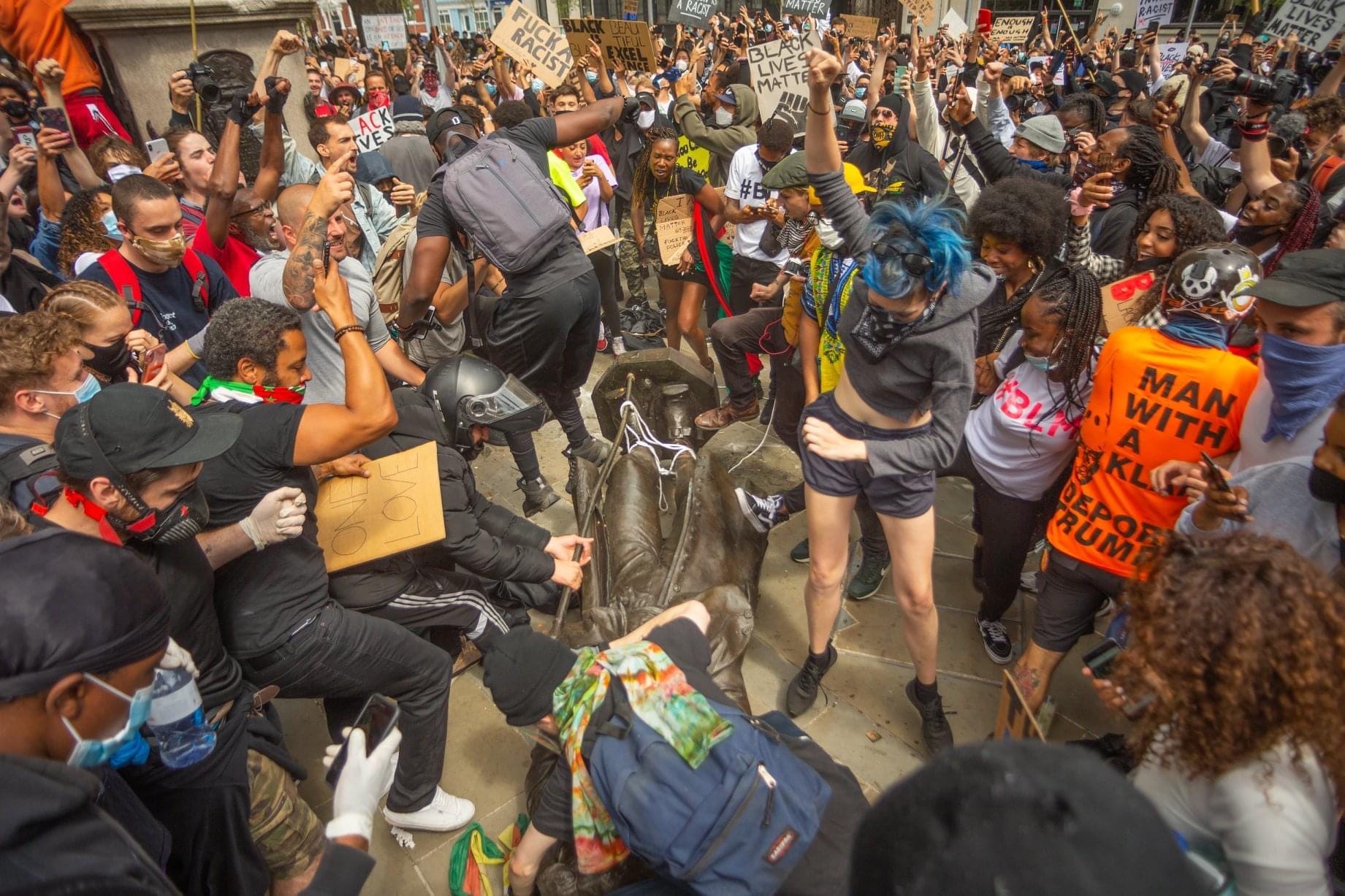
Oh—if we could only relive the moment when our brethrens of Bristol toppled the statue of Edward Colston! It was a watershed moment, to see people bypass the bureaucracy involved with decommissioning a statue, and throw the bronze slave trader into the Bristol Harbour with nothing but rope and rage. The idea that statues like Colston should remain in place because they help to educate the public about the realities of the past is a relatively new concept. The 20th century saw only two monuments in the whole of the UK that mentioned slavery. It wasn’t until 2019, that the plaque for Colston attempted to display his “full history,” and even then, the plaque lead with his “good deeds,” opening with the lines:
Edward Colston (1636-1721), MP for Bristol (1710-1713), was one of this city’s greatest benefactors. He supported and endowed schools, alms-houses, hospitals and churches in Bristol, London and elsewhere.
Details about his role in the slave trade had been added (albeit secondary his philanthropy work) but they had been omitted for the preceding 124 years. Some may say that omitting details or minimising the gruesome parts of someone’s life on a plaque is a casualty of word count, but it only proves that statues can never truly be used as educational tools if they cannot reveal the totality of the subject’s legacy. Statues aren’t just these benign objects that exist to embellish city streets—they are often weapons of mass misrepresentation.
During The Reconstruction era (1865-1877), following the American Civil War — the economic, political and ideological legacy of slavery meant that building social cohesion was necessary to avoid social unrest. Freed slaves needed to be integrated back into society and public monuments became important in moulding history into a “rightful pattern,” but it was difficult to build a “democratic memory of their collective past”, according to Standing Soldiers, Kneeling Slaves: Race, War, and Monument in Nineteenth-Century America by art historian Kirk Savage. Slavery couldn’t be acknowledged without “exploding the myth of a democratically unified people from the very outset,” Savage writes.
“Once abolished, slavery forced itself into the domain of memory, there to be reckoned with in one way or another-suppressed, integrated, romanticized. Emancipation introduced into national memory a new people (some four million ex-slaves) and a new history (their history of enslavement). “The people” now included slaveowner and slave alike, multiple and opposing histories united under the same banner of the nation.”
He continues:
“Public monuments are the most conservative of commemorative forms precisely because they are meant to last, unchanged, forever. While other things come and go, are lost and forgotten, the monument is supposed to remain a fixed point, stabilizing both the physical and the cognitive landscape. Monuments attempt to mold a landscape of collective memory, to conserve what is worth remembering and discard the rest.”
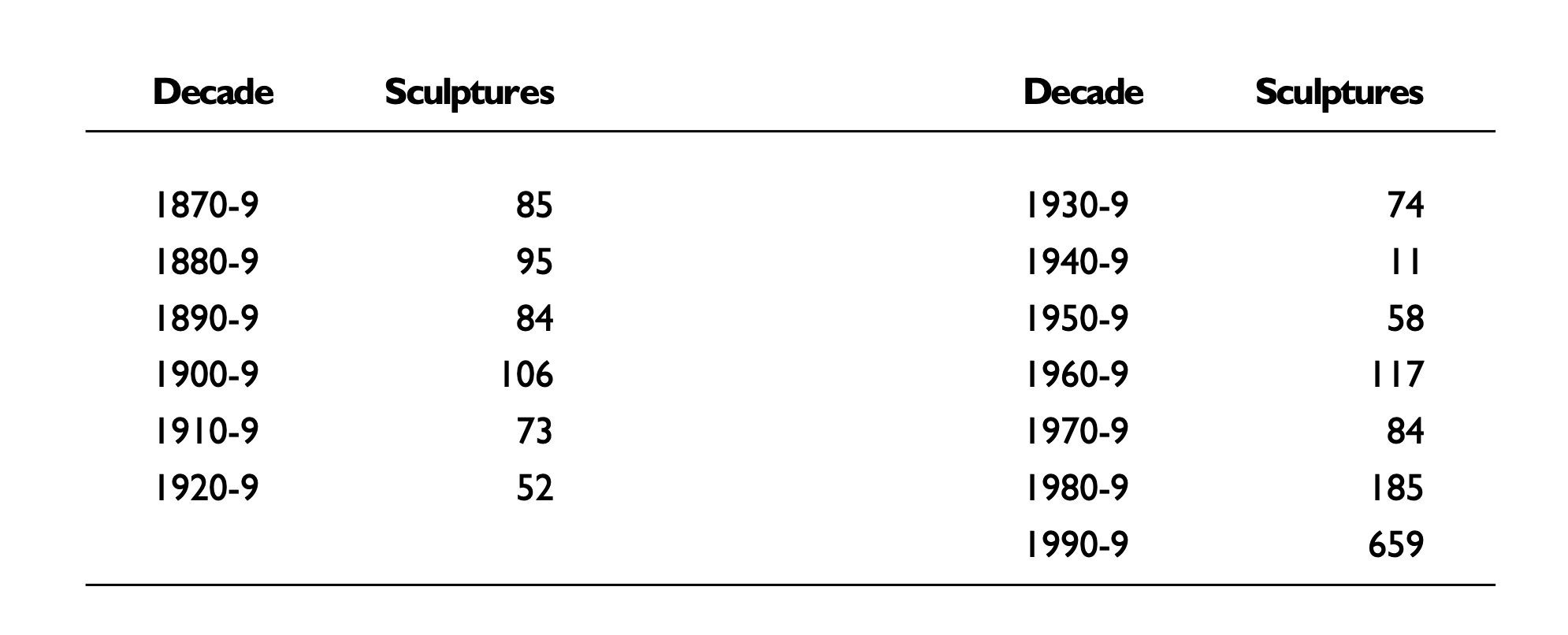
Post-war Britain saw a rise in public sculptures too. They were erected to promote unity and bring life back to public space following the structural destruction caused by the war. But it was the years between 1990-1999, that statue building accelerated. The UK erected 659 public sculptures during this time—more than the amount of public sculptures erected between 1910-1989 combined. This boom was a result of growing commissioning bodies and access to National Lottery and European funding. This is how Antony Gormley’s Angel of the North came to be. Still, most of the subjects were, politicians, military heroes and historic figures.
Following the rise of the Black Lives Matter movement, public statues honouring racist figures came under great scrutiny. In 2023, the Rishi Sunak-led Conservative government published a ‘Retain and Explain’ policy regarding controversial public statues. Then UK culture secretary Lucy Frazer explained in the statement that cultural institutions should resist being driven by any politics or agenda and should use their assets to educate and inform rather than to seek to erase “uncomfortable parts” of history.
But how can a statue be presented with its “uncomfortable parts” when they are often positioned as sites of celebration and commemoration? As I said above, education is an improbable avenue because a statue by nature is glorification. If anything, the removal of a statue brings its history back into public consciousness which then allows for new opportunities to learn. The Rhodes Must Fall movement of 2015 saw student campaingers fight for the removal of a statue at the University of Cape Town commemorating coloniser Cecil Rhodes. It got everyone talking about the murderous man. Campaigners faced accusation of being anti-history, but I have never bought into the idea that important parts of history should be told via a sculpture of someone’s body or a bust. Why must I learn about significant world events by gazing upon some dead man’s “noble” chest? What use is engaging with objects of the past if we don’t use them to restructure our present landscape? What use is a static, irremovable, incontestable object to a mortal species? Gary Younge wrote a great piece for the Guardian in 2021 on why he believes every statue should come down:
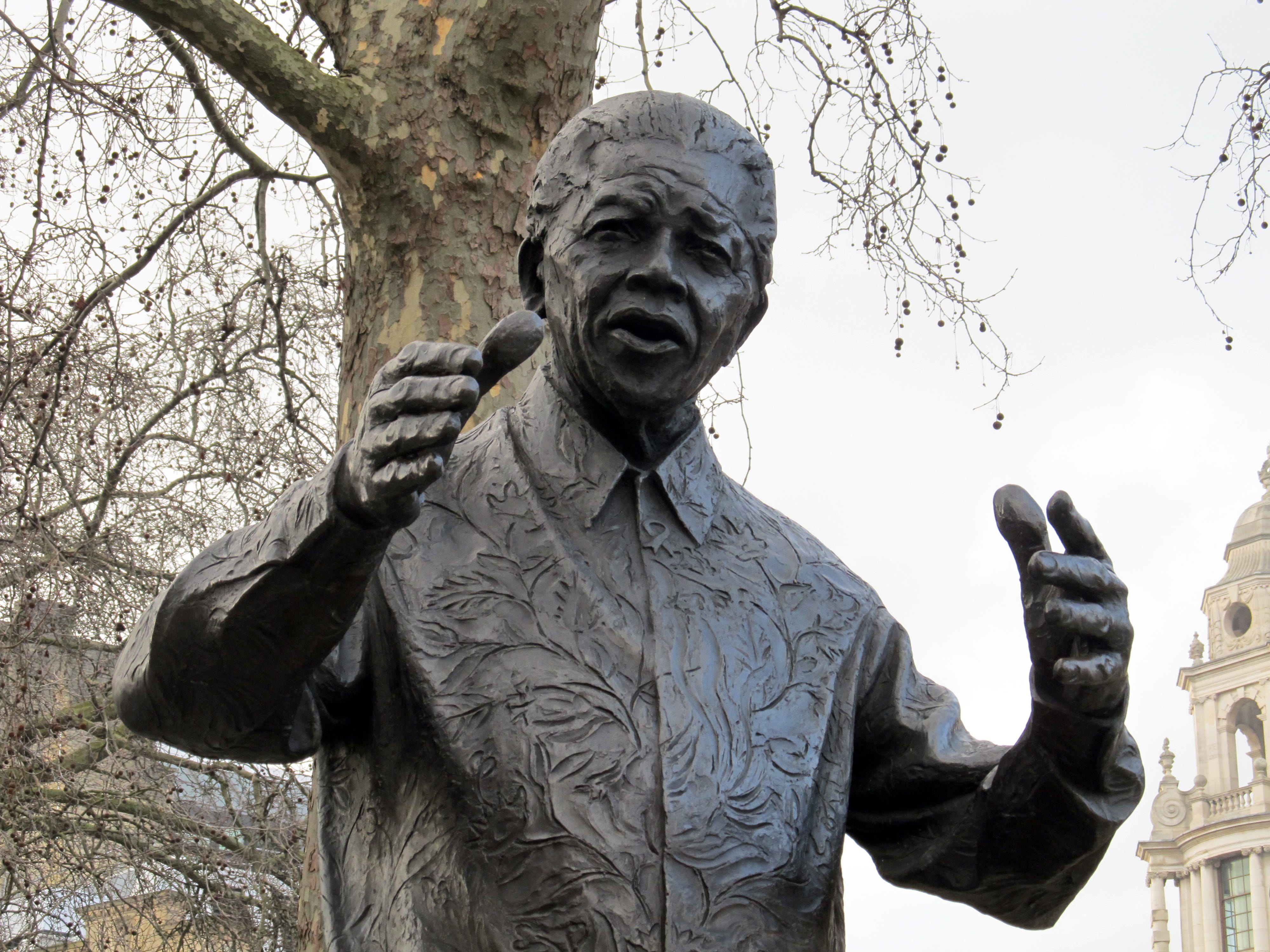
“Take down the slave traders, imperial conquerors, colonial murderers, warmongers and genocidal exploiters. But while you’re at it, take down the freedom fighters, trade unionists, human rights champions and revolutionaries. Yes, remove Columbus, Leopold II, Colston and Rhodes. But take down Mandela, Gandhi, Seacole and Tubman, too.
I don’t think those two groups are moral equals. I place great value on those who fought for equality and inclusion and against bigotry and privilege. But their value to me need not be set in stone and raised on a pedestal. My sense of self-worth is not contingent on seeing those who represent my viewpoints.”
Now—I’m not necessarily calling for the removal of all statues. I just think we need an audit, before we start building more, even the ones of Black people. I know we represent just 2% of all UK public statues as of 2021, but I agree with Younge in that looking for self-worth in statues is futile. When Thomas J. Price’s statue Grounded in the Stars was erected in Time Square last summer, it received wave of backlash. Many felt that the 12-ft figure of a Black woman with her hands on her hips, was a misrepresentation. That the figure appeared angry in some way and fed into old tropes about Black women. But the main critique I heard was that it was ugly and fat. That it was unflattering, unattractive. Nothing redeemable about it. One TikToker said: “They don’t want Black women to be pretty.”
Price’s statue is probably the closest to what I would actually consider to be a public statue worthy of erecting. It’s of no particular person, no celebrity or war criminal, no artist whose merit is decided by the times. It’s not mythical and thus infallible. It’s not aspirational in a capitalist kind of way. It’s just a figure. And yet, when you have a demographic that is historically underrepresented in monuments and statues, it is going to be near impossible to satisfy them, because of the very underrepresentation you’re trying to redress. They don’t want to see anything remotely “average” or “ordinary”. So what now?
On the other end of the spectrum, you have technofascists trying to build mega statues to promote individualism. Last year, Bloomberg published a piece about a crypto investor called Ross Calvin Seven who planned to build a 450-ft statue of Prometheus on Alcatraz island. Prometheus, in Greek mythology, was the titan who built humanity from clay and defied Zeus by stealing fire from the gods and giving it to mortals. I click on the promotional website. It says AMERICAN COLOSSUS in bold sans serif. The manifesto talks about Prometheus’ foresight, free will and self-determination. It’s all cult-speak.
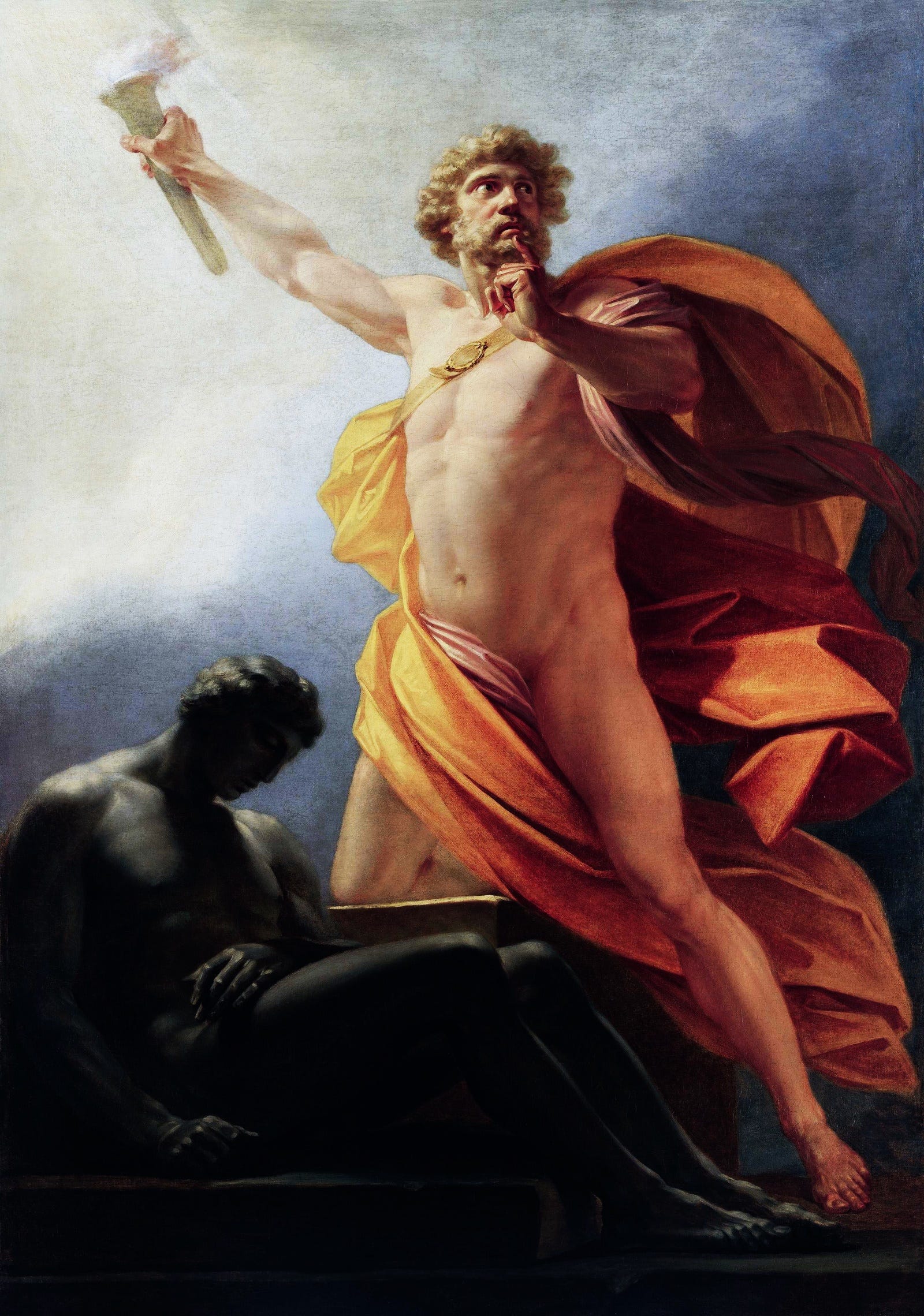
If it wasn’t already obvious by the project title alone, that this is the work of the far-right, the below makes it crystal clear:
“The Promethean, to which all are deeply called to aspire, has no tolerance for the pseudo moral outrage which demands so-called ‘social justice’ by valorizing disability and resentfully desecrating everything that which memorializes the achievement of those who excelled in their endevours. The Promethean is a triumphant calling, not a mugger in an underpass.”
What the actual fuck? lol.
More madness here:
“The Colossal Monument to Prometheus declares that governments unchain all economic dynamism to empower the industrious individual and to protect people from a dehumanization and degradation of their existence.”
The page ends with “Man is Rising”. There are several more pages on the website that talk about Prometheus at length. One titled “You can’t tear this one down,” blames “social justice warriors ” and “Black Lives Matter ” for destroying America’s educational system with equity and fairness. Then there’s a long rant about how cultural marxism is responsible for anti-Western and anti-American indoctrination. The project sounds absurd, but can you show me a statue born from pure altruism? Statues have always been erected during moments of uncertainty and fog. When there is deep discord and conflict is either recent or imminent. As art historian Benjamin Buchloh argues (as discussed in this text by Rachel Wells): “enormous public monuments are signs of a time of insecurity and uncertainty, as if they are attempts to cement a view of history and the present when it is at its most watery and weak. The ‘stability and weight’ of colossal structures offer ‘balance’ to such insecurity and fill the ‘gaps of historic identity’.”
We only need to look to 19th century France to see these systems at play. During the Franco-Prussian War of 1870, the French army had surrendered to Prussia and a revolutionary government known as The Paris Commune seized control of Paris in March 1871 and controlled parts of the city until 28 May 1871. The Paris Commune’s motivations were progressive—they wanted equality for the sexes, separation of church and state, free education, and the seizure and redistribution of unoccupied housing.
After Semaine sanglante (the Bloody Week) which saw government troops massacre 25,000 people, resulting in the Paris Commune’s fall, the French government, known as the Third Republic sought to cover up the Paris Commune’s socialist and anarchist politics that lingered on with monuments. Many many monuments. So many in fact, the frenzy was called “Statuemania”. At least 150 monuments dedicated to individuals were erected during this time. Creating a suitable “sculptural image” of modern France was paramount, as was erasing all collective memory of the revolt.
Writing in Index Journal, Ursula Cornelia de Leeuw notes:
The Third Republic rushed to secure the national identity of France through the widespread construction of statues and monuments. The already precarious ideals of the republic, further unsettled by the spectre of the Paris Commune, teetered atop three factions: the republicans, the monarchists, and the Bonapartists. These coalitions competed to imprint their particular vision on the city streets.
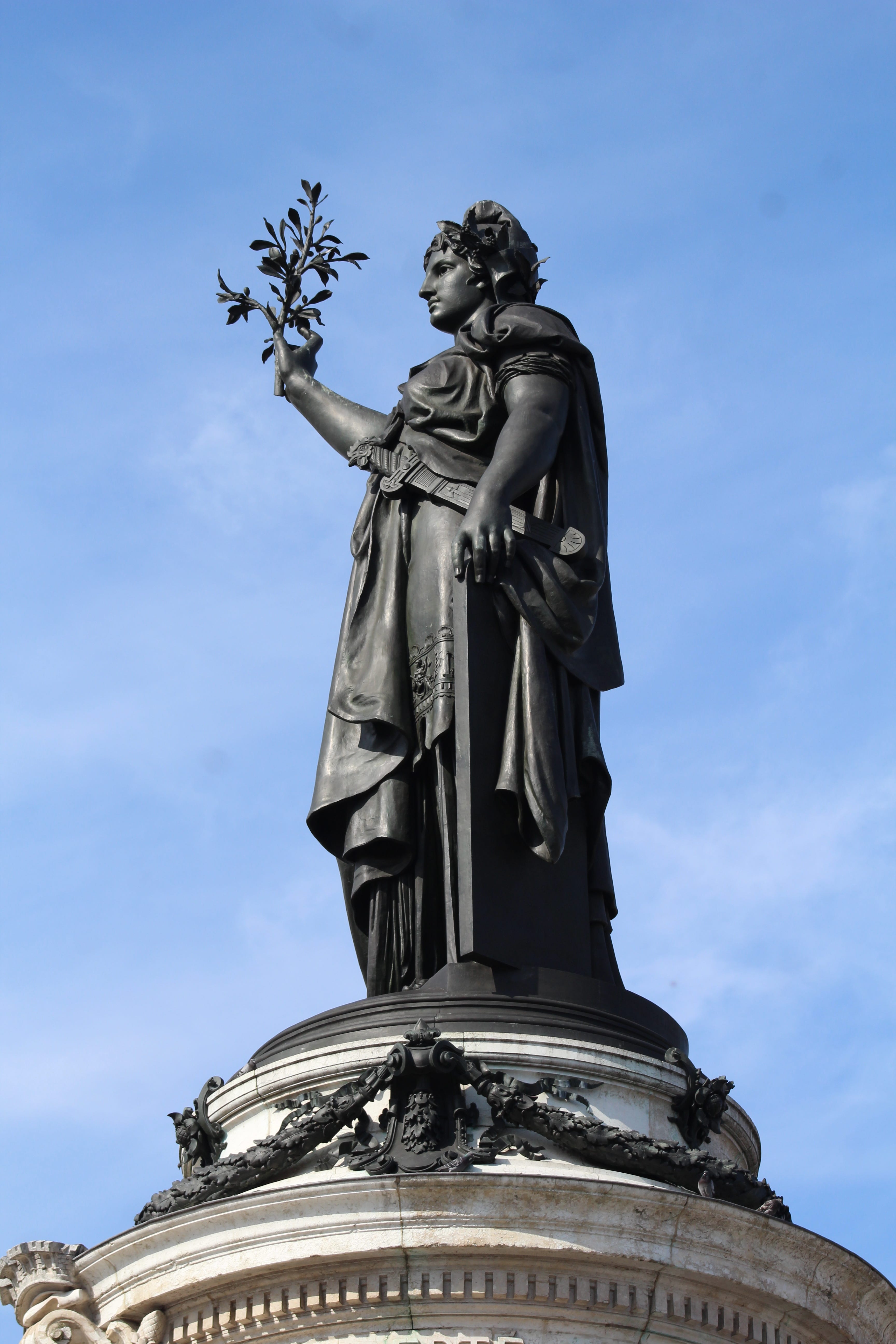
In 1883, Monument à la République was installed in Place du Château d’Eau — an area that was home to a large proletarian community which had been a significant stronghold to the Paris Commune during Semaine sanglante. Erecting the statue here sent a clear message about who held power. The sculpture was of Marianne, a personification of the French Republic, a woman who represented freedom and liberty. She held an olive branch, a symbol of peace, yet during the monument inauguration speech, Prefect of Siene, Louis Oustry, was said to have briefly mentioned “the commundard’s destruction of Paris”, and remarked that a “new era was upon France, that there was no more tearing down, but rebuilding in the name of republicanism.”
We hear a lot about how the toppling of statues is a form of censorship, that it erases history, but what about instances where the proliferation of statues obfuscates parts of the past or present that go against the dominant political narrative? We have to consider what history is destroyed in the wake of erection.
Still, if it’s wrong to melt or grind the ones we already have down or banish them to Tussauds, can we agree to stop….building….more? I’ll leave you with this article published in The New York Times in 1911. Different century. Same energy.
“PARIS, July 13.-The Paris Municipal Council this week took a remarkable step, which will be universally approved. It has made a stand against what it describes as the “statue mania.” A resolution has been brought in and favorably reported on that no new statues shall be erected in Paris for ten years to come, no matter what may be the claims to immortality of the candidates for honors in bronze or marble.
Of late years there has been an epidemic of statues, busts, bas rellefs, &c., commemorating the virtues of obscure individuals, of whom their fellow-citizens often first heard when they were perpetuated in some public square. The custom became so scandalous that the late Armand Sylvestre (who has since then himself got his monument) proposed that the city should erect few hundred pedestals, on which the “celebrities” (?) would be exhibited each in his turn for a week. Thus fifty-two local glories could be brought to the memory of their fellow-citizens once a year.
The ten years’ term now proposed will, of course, excite discontent among the sculptors, who have alone been the gainers under the present state of things. Half the persons who would to-day get monuments will be forgotten when the half decade is past.”